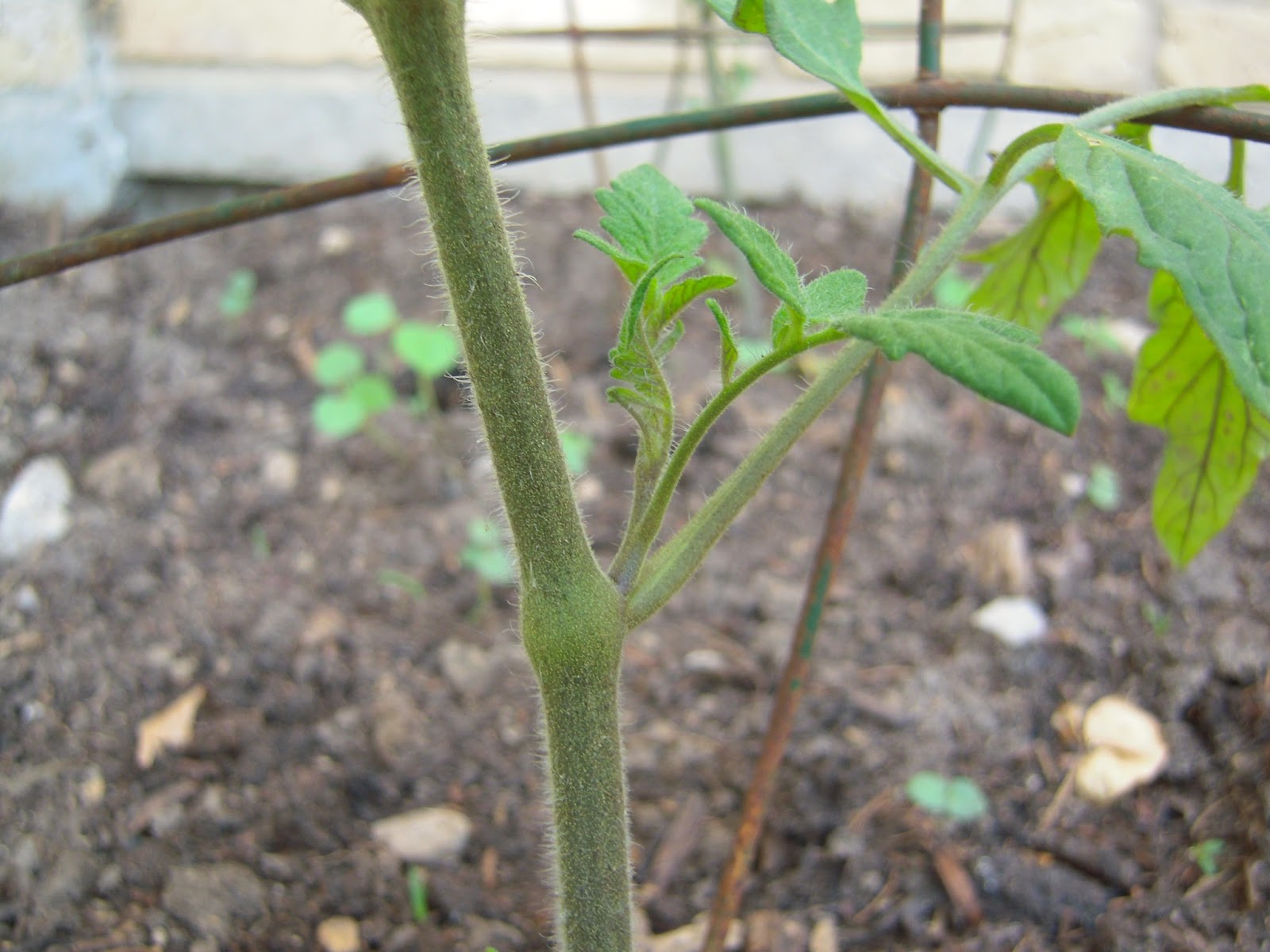
Pruning or pinching these stems are the terms used to remove them. So run outside quickly right now like I did and pinch those suckers off your tomato plants so that they can grow nice and tall and straight and help to produce even more yumcious tomatoes.
Saturday, June 22, 2013
Tomato Suckers
I read this term for the first time today and had no idea what it was so looked it up. Suckers are the little extra plant growth at the base of a tomato stem where it meets the main stem.
Pallet Garden
We have lots of deer, rabbits, raccoon, squirrels, fox, and any other wild life critters around our property. Leaving my vegetable garden unprotected is out of the question. Hence I came up with a partial pallet fence to surround it.
I did not surround the entire garden with pallets as it faces the east and I didn't want early morning sun to cast a shadow on the garden.
This way it gets full sunshine all day long.
Hopefully the fencing is enough to deter free loaders. It sure would be nice to harvest something edible this year.
Friday, June 21, 2013
Alteration
So I made a slight alteration to my chicken mobile.
I removed the tarp which was working and keeping the chickens from roosting, but it was a pain in the butt to open and close the coop door every day. I'd have to remove the tarp, open the pen, place a board in front of the door, lug a very huge boulder over to sit in front of the door and then repeat all this when letting the chicks out in the morning. So instead, I joined the dog pen together to form one big round exercise area for them, placing one of the pen doors in front of the coop door so that it is open to the inside of the pen.
I stapled that part of the pen right to the coop. So all I have to do is open the pen door and the chicks can come and go freely into the coop.
A bungy cord keeps the door open and also acts as an additional latch when they are closed up at night. And the best part, there's no chance of roosting.
Infested
We live in a very old house and anyone who lives in an old house knows that not only does it come with history and character, your old house also comes pre-occupied. And I don't mean the other world ghostly kind of occupants. (Though your house probably has those as well.) No, I'm referring to the rodent kind. In our first summer here, we had a total of 8 bats inside the house. Not all at once, but that certainly was enough numbers to know we had a problem and that the bats were entering through the house rather than from a door or window left open. It took one night while I was sitting in my bedroom watching television that something from my window caught my attention. There was a bat peeking around from the trim of the window. Yes, the trim. Not from any part of the window that actually had excess to the outside. No, he was coming from the wall.
As it turned out we discovered that on the other side of this wall was a brick chimney that had obviously been crumbling over the years. The result left a gap between the chimney and the actual house. A perfect location for a colony of bats. We were horrified to watch at dask the "flight of the bats". That was what we began calling it. Endless number of bats flew out from this gap and consequently my house. It was sickening to realize that many number of bats were housed just on the other side of my bedroom.
The other rodent we have had major issues with is the good old field mouse. We find mouse droppings everywhere but particularly in the kitchen. We cannot put anything in the bottom cabinets that is important because they somehow get in there. We have killed so many mice I couldn't even begin to count them. We have removed all the cabinets and blocked any access to the kitchen from pipe holes or cracks along the baseboards but still the mice come. And with an old house, it is next to impossible to figure out how they are actually entering the house period. There are so many gaps and cracks along the foundation that it only takes the width of an inch for a mouse to slip through.
Our house walls are alive with our neighbours. You can hear them running from one room to another. It's nasty. So is the mess they leave behind. And killing them is not so easy. Not only are those little buggers sometimes very illusive when it comes to actually getting snared, but you have to be very agile when setting the traps. Many a times I've lost my cool trying to get that little flimsy bar to keep the snare part of the trap down. But then I decided to try a new trap. It cost more than the cheap dollar trap, but I was willing to try anything. And it's a good thing I did.
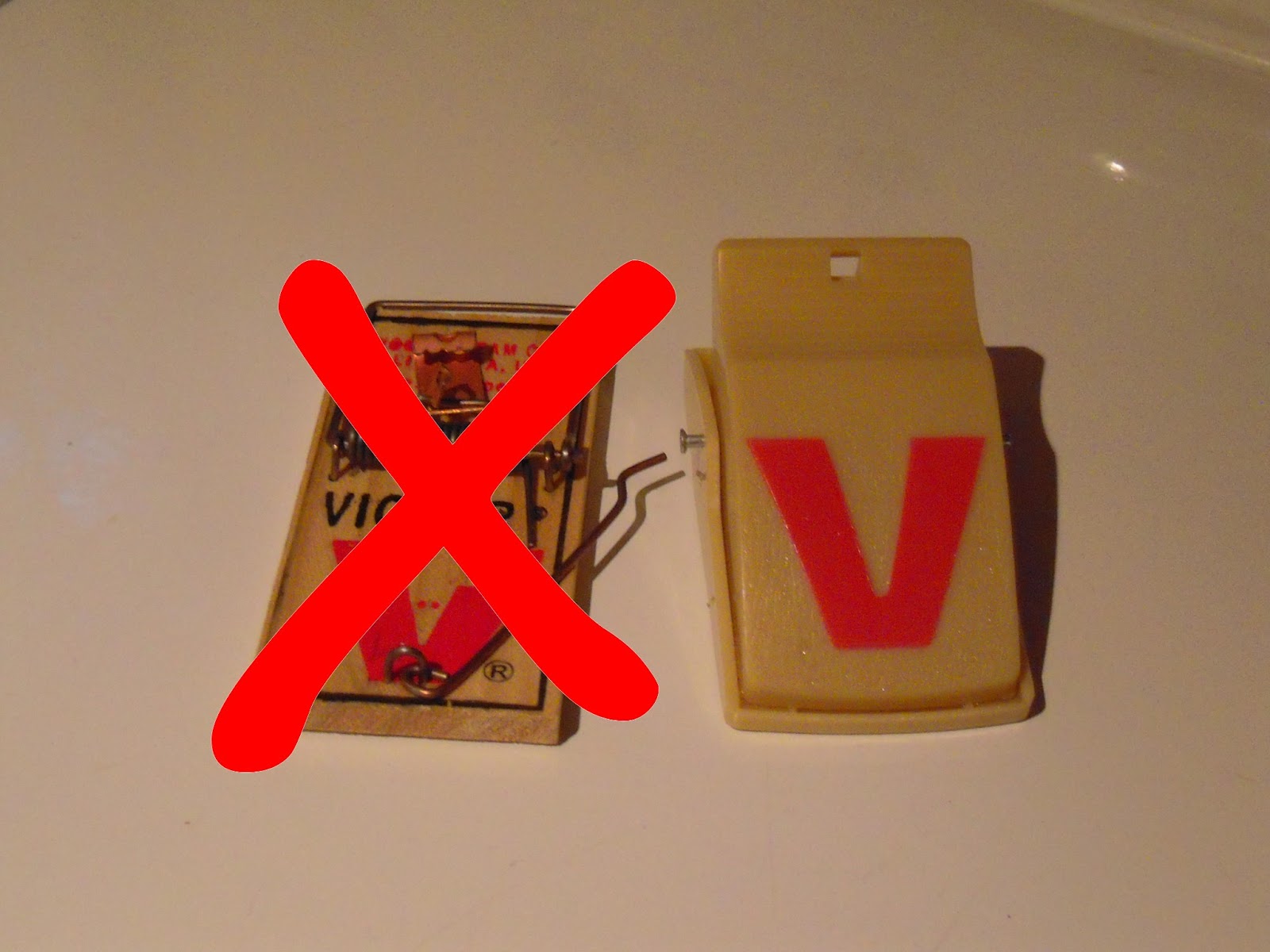
The trap above on the left is the cheap, very effective but nearly impossible to set trap and the one on the right is the new, simple, easy to set and reusable trap. Yes, that's right. No throwing the trap out with the mouse. You simple squeeze the trap back open and dump your dead rodent in the trash. This trap was so worth every extra dollar I spent on it. No more getting my fingers snapped or spending an hour trying to balance that little flimsy bar over the trap. It takes seconds, literally, to set. We had a mouse in the kitchen so I went out and bought one of these but forgot to set it last night. Or maybe I didn't but was just too dang tired to stay up longer trying to set the mouse trap. So when I came downstairs this morning and found more mouse droppings, I opened the new trap, placed a small piece of bread with peanut butter on it, set it on the counter, put the kettle on, went to check my email and while at my computer heard the snap. Yep, that quick, that effficient. Now, if I could only figure out how to use it on bats.
Wednesday, June 19, 2013
Tuesday, June 18, 2013
Week 7
The new chicken mobile has been working. We haven't lost a single chick to cold or predators. I have to tell you, with their bare bottoms it was a big concern to me and the hubs.
We thought we'd loose many to cold overnight since they were so exposed. But thankfully, that hasn't happened. We're not one hundred percent why the bare bottoms other than either they were so hungry they began to eat each others feathers or more likely, it was so hot in the greenhouse they were plucking the feathers to remain cool. We have rotated the mobile coop which was no easy feat as I hadn't attached wheels or a draw rope. But we did manage to maneuver it and only ran over one or fourty chicken feet in the process, but they are on fresh grass and fertilizing my yard like good little chickens.
The tarp has replaced the flimsy canopy to prevent roosting on the mobile coop's roof. It works pretty decent but still the odd chicken will somehow manage to fly over the tarp. Behind them is the trail where the mobile unit was before.
As you can see, the area where the coop was sitting takes the worse abuse on the grass. There's not much I can do about that since they spend all night cramped in there together, other then rotating them more frequently. But since it is a pain in the butt, it will just have to suffer for a couple more weeks.
The chicks have been getting bigger but don't think they are ready for slaughter so we are opting to let them grow longer.
Putting them on pasture might have hurried their growing but I'm okay with them taking a few more weeks. I don't have customers waiting for these chicks so no pressure to finish them off in time.
Monday, June 17, 2013
Getting to Know Your Grass
Before I talk about grass, I just wanted to update how things were going in the mini pasture. I think this photo says it all.
This one is the only one I know for certain. It is timothy.
I'm thinking this is some kind of fescue grass?
This photo is a bit unclear (the result of trying to take photos of grass on a windy day) but believe it is Bromegrass.
I'm at a loss for this one.
This braided looking type of grass I think might be quack grass.
This one I'm thinking is Kentucky bluegrass.
This is red clover, I'm pretty certain.
Hmm? Canada Bluegrass maybe?
Here is that braided looking grass again.
That's Blossom staying cool underneath the Willow tree with, well, Willow, and Tex. And Mamma, Pixie, was comfortable enough with this scenario to graze at a distance.
But now, back to grass. In the winter I did a post regarding getting to know your hay. Just important, if not more, is getting to know your grass. I am still learning so come along and learn with me.
My pasture does not look as wonderful as this. In fact, I am pretty certain even in full bloom it wouldn't look as plentiful as this. To the average person, this is a lot with unmowed grass. That was exactly how I looked at it when I first moved here. A nuisance, a pain-in-the-butt lot. But to the horses, this is a smorgasbord! Come with me as I get up close and personal with the different kinds of grass found within.
This here grass I believe is orchard grass, or not. The jury is still out on that.
This one is the only one I know for certain. It is timothy.
I'm thinking this is some kind of fescue grass?
This photo is a bit unclear (the result of trying to take photos of grass on a windy day) but believe it is Bromegrass.
I'm at a loss for this one.
This braided looking type of grass I think might be quack grass.
This one I'm thinking is Kentucky bluegrass.
This is red clover, I'm pretty certain.
Hmm? Canada Bluegrass maybe?
Here is that braided looking grass again.
Okay, so I hope noone comes to this blog entry hoping to learn to identify their grass blades, because it is a lot harder than you think. They all look so different yet look exactly the same. Whatever their breed of grass, the horses love each and every one. As a treat I may take a bouquet of these grasses to the miniatures.
Or a bucket full for the horses.
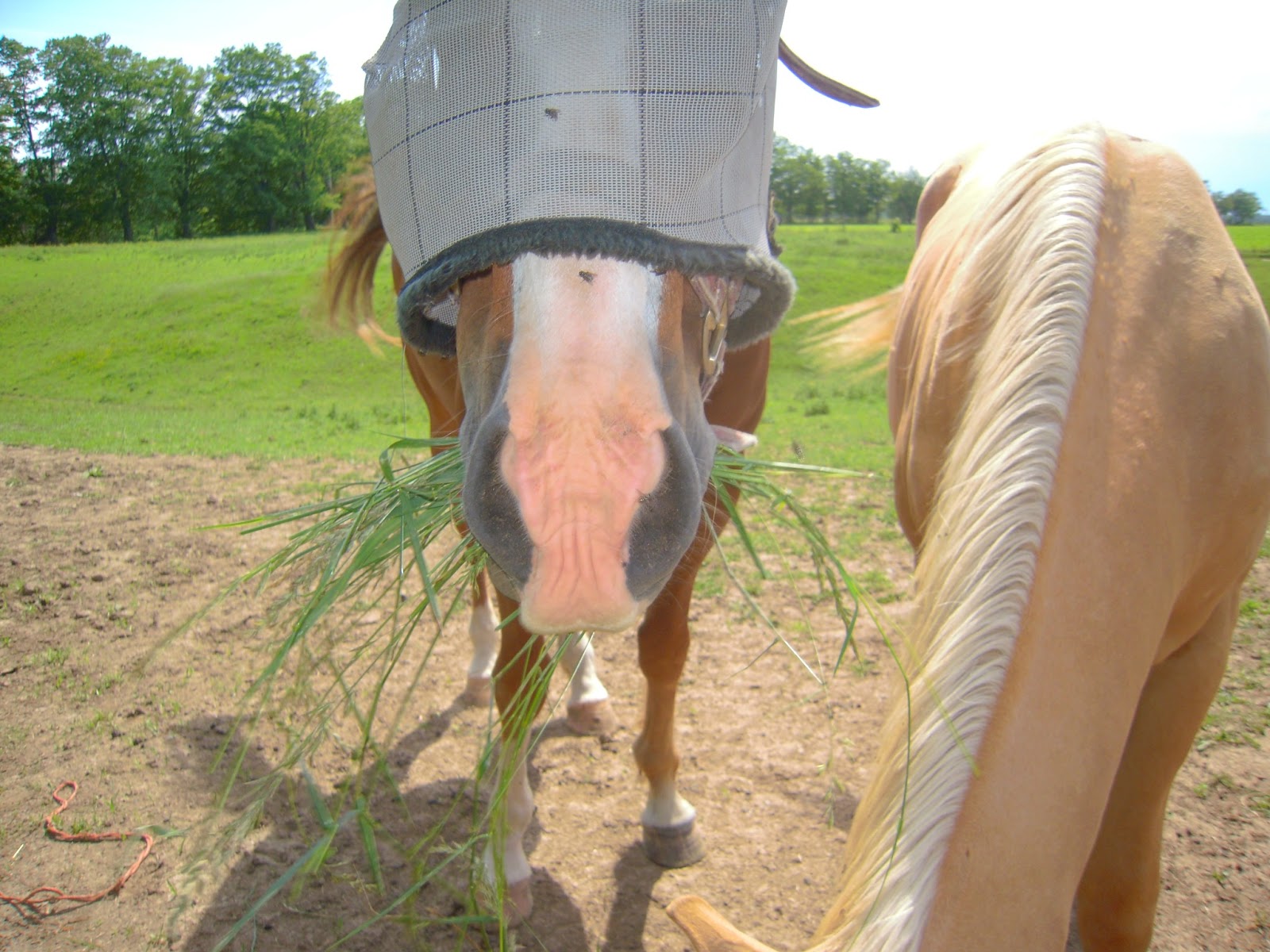
Aussie enjoying his treat of yummy morsels.
They don't care what you name it, they can identify it with just one sniff. Try giving them any other grass and they'll turn their nose away. I think it would be fabulous to be able to identify whether a food is good and healthy for you simply by smelling it.
Subscribe to:
Posts (Atom)